Creator Merch Without Inventory: A Practical Print on Demand Guide for Small Creators
Print on demand lets small creators sell merch without buying stock first. This guide covers choosing products and providers, pricing from real costs, and launching a first drop that fits a small audience.
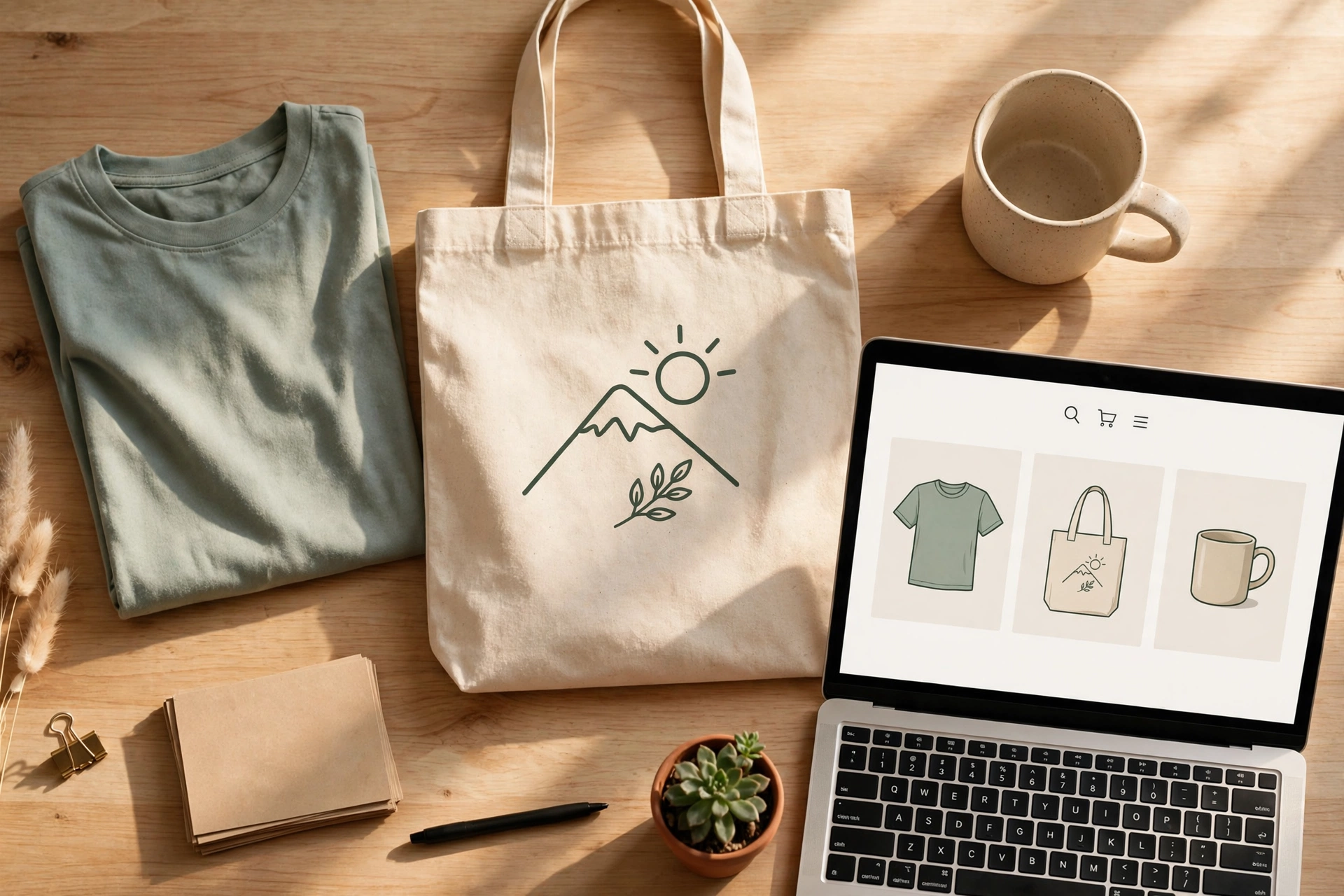
Every creator has heard the same merch advice: design a shirt, print a hundred of them, and hope they sell. For a small creator, that advice is backwards — you pay upfront, store boxes in a spare room, and own the loss if the design flops. Print on demand merch for creators flips that order: you design once, list the product, and the item is only printed after a customer has already paid. No stock, no boxes, no gamble on sizes nobody orders. This guide explains how the model works, how to choose your first products, how to price them honestly, and how to launch a first drop that does not embarrass you.
What print on demand merch actually is
Print on demand, usually shortened to POD, is a fulfilment model, not a shop. You place a design on a blank product — a T-shirt, hoodie, mug or tote bag — in a print provider's catalogue and list it in your own store or on a marketplace. When a customer buys it, the order goes automatically to the provider, who prints, packs and ships it directly to the buyer. You never touch the product. Your profit is the retail price minus the provider's base cost plus shipping, minus store and payment fees.
That also defines what POD is not: free money. Margins are thinner than bulk printing, delivery takes longer because the item is printed after ordering, and quality and shipping speed are largely in your provider's hands.
Start with the audience, not the product
The most common POD mistake is designing first and finding buyers later. A shirt that says something clever means nothing if nobody recognises the reference. Start instead from a sentence your audience already says: a fitness creator whose viewers repeat a leg-day catchphrase has a product, as does a study creator whose audience jokes about 5 a.m. revision sessions.
Test the sentence before you spend a week on artwork: post it as a caption or poll and watch whether people repeat it back in comments. If ten people quote it unprompted, you have demand. A tiny, specific audience also beats a huge, vague one — a design for "home workout people who train before their kids wake up" has almost no competition, while a design for "people who like gym" competes with every gym shirt online.
Pick your first three products — and nothing more
A first drop should be small enough to do well. Three products is plenty: one wearable, one everyday item, and one lower-priced item that lets a hesitant fan buy in. A T-shirt is the obvious wearable, though a hoodie suits colder audiences better. A mug or tote bag makes a good everyday item because the print area is simple and the price stays approachable. A sticker works as the low-priced entry point, though margins there are thin — treat it as a way to win a first purchase, not a profit engine.
Order samples of all three before you launch. Wear the shirt, wash it twice, drink from the mug, carry the tote for a week, and check whether the print cracks or fades. If a sample disappoints you, change the product or provider now, not after fifty customers have complained.
Printful, Printify and Gelato: how to choose a provider
The three names you will meet most often are Printful, Printify and Gelato, and they are not interchangeable. Printful runs its own fulfilment centres, which tends to mean more consistent quality and branding options such as custom packaging, but often higher base prices. Printify is a network of independent print partners, so prices and quality can vary by partner — check reviews for the specific partner you choose. Gelato uses local printers in many countries, which can mean faster delivery for international buyers, and it is particularly strong on posters and stationery.
Choose on three questions, in this order. First, does the provider ship affordably to the countries where most of your audience lives? A provider cheap for US buyers can be slow and expensive for Indian buyers, and shipping time is the complaint that kills repeat sales. Second, does it carry the exact product and print method you want, in the sizes your audience needs? Third, what is the true base cost including shipping — not just the headline product price? Check the current catalogue before you commit, because base prices change.
Price it so you actually keep something
POD pricing is simple arithmetic, and most creators skip one term: profit per item equals retail price, minus base cost, minus shipping if you absorb it, minus store and payment fees. Take a made-up example: base cost $14, shipping $5, fees about $2 — total cost $21. Sell at $28 and you keep about $7; sell at $24 out of fear of looking expensive and you keep about $3, which one return wipes out.
Two habits protect your margin. First, build shipping into the retail price and offer "free shipping" where you can, rather than surprising buyers with a large charge at checkout — that surprise is what causes abandoned carts. Second, resist launching with a discount, which trains early buyers to wait for the next one. Offer something personal instead, such as a limited colour that will not be restocked. The same pricing discipline applies to anything else you sell, as our beginner's guide to selling digital products as a creator also shows; and our guide to pricing your digital products without underselling yourself walks through the same trap — pricing from fear instead of from costs — in more detail.
A first-drop launch plan that fits a small audience
A good first drop is a two-week story, not a single announcement post. In week one, show the process: sketches, the sample arriving, you wearing it and asking for honest opinions. Let your audience help choose between two colours or phrases. In week two, open sales for a defined window — say ten days — and say clearly when it closes.
On launch day, make one clear post that shows the product on a real person, states the price including shipping, and links directly to the product page. After the window closes, report back honestly — how many sold, what you learned, what comes next. That follow-up is what turns a one-time buyer into someone who returns for the second drop.
Mistakes that quietly kill creator merch
Three boring mistakes deserve special attention, which is why creators keep making them. First, using someone else's art, lyrics, logos, or trademarked characters: a phrase from a popular show or a sports team's logo can get your listing removed and your account flagged, and "everyone does it" is not a defence — use only original or properly licensed artwork and keep the receipt. Second, uploading a low-resolution image: print needs a high-resolution file, typically 300 dots per inch at full print size, in PNG format with a transparent background where the product colour should show through. A compressed social media image will print blurry, and the buyer will blame you. Third, promising delivery dates you do not control: always quote the provider's production plus shipping range with a few days of buffer. A buyer told "two to three weeks" who receives the item in ten days is delighted; one promised "five days" who waits three weeks is lost.
Frequently asked questions
Do I need a registered business to start print on demand merch? In most cases you can start as an individual under your own name, but tax and registration rules depend on your country and income level. If sales grow beyond a hobby, speak to a local accountant before you scale.
How much money do I need to start? Listing products is usually free; your real costs are samples, a store plan if you use your own shop, and a small amount of promotion. Ordering one sample of each product is the single most useful expense.
Can I sell print on demand merch on Etsy as well as my own store? Yes, most major providers integrate with both. Your own store gives you control over branding and customer data; a marketplace gives you built-in search traffic but also fees and rules.
What happens when a customer wants a return? It depends on the provider and the reason: printing errors and damaged items are usually reprinted or refunded, while a wrong size ordered by the customer is often the customer's cost. State your return policy on the product page before launch so your promise matches the provider's policy.
Print on demand merch works best as a small, honest extension of work your audience already loves — not as a lottery ticket. Pick one audience, one phrase they already repeat, three products you have actually held, and a price built from real costs. Launch in a short window, report back, and let the second drop be shaped by what the first taught you. For the official mechanics of how the model works, Shopify's print on demand guide and Printful's print on demand overview are both worth reading before you choose a provider.