Licensing Your Digital Products: PLR, MRR, and Resell Rights Explained
Confused by PLR, MRR, and resell rights? A plain-English guide to digital product licensing: what each license allows, which one fits your product, and how to price and write license terms that protect you.
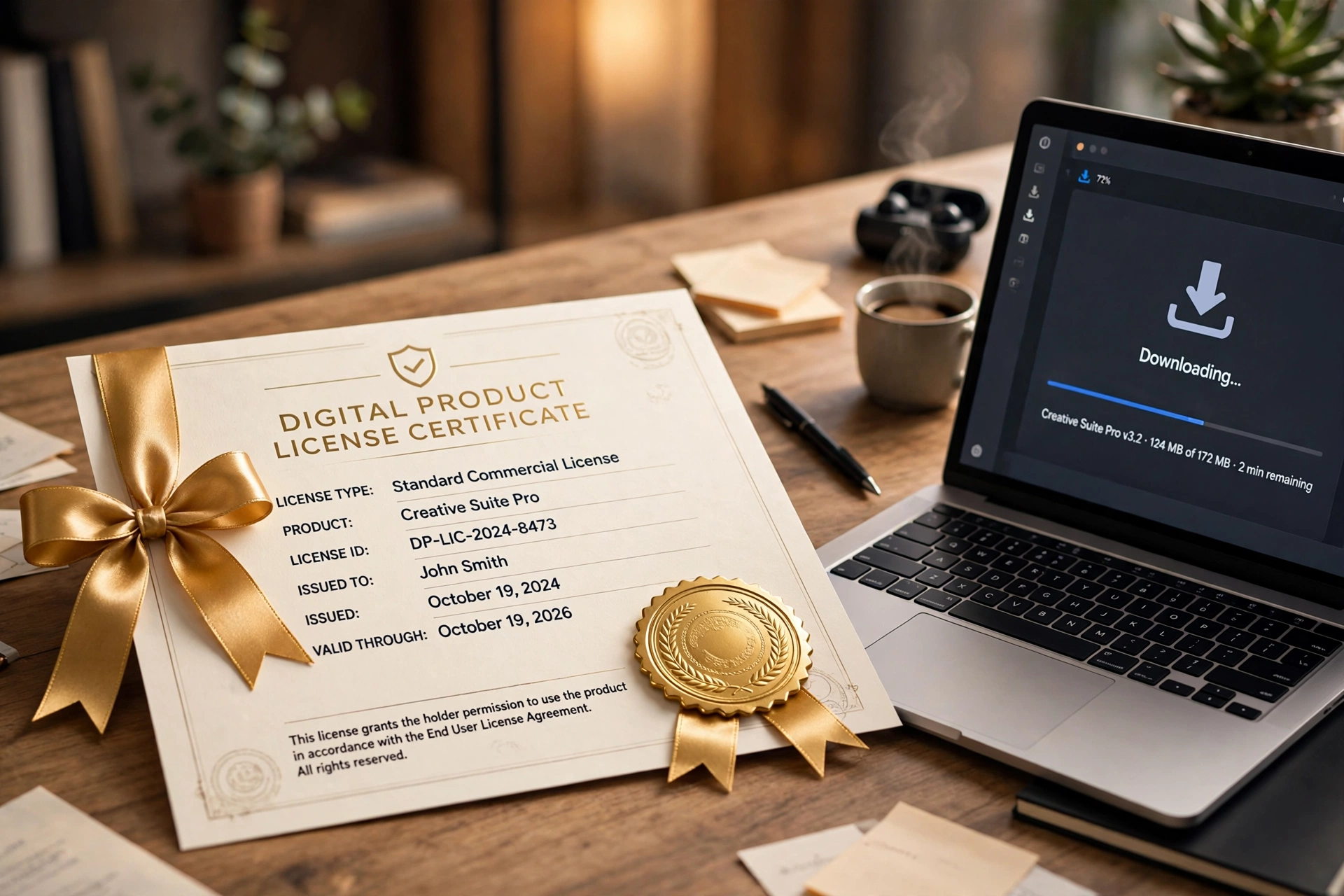
You finished your ebook, template pack, or course — and then a buyer asks, "Can I resell this?" Your stomach drops. You never thought about licensing, and now you are one confused reply away from either giving away your rights for free or scaring off a good customer. This is the moment most creators realize that a digital product is not just a file — it is a bundle of rights, and the license decides who can do what with it.
Licensing sounds legal and intimidating, but the core idea is simple: you are telling buyers exactly what they are allowed to do with your product. Get it right, and licensing becomes a revenue multiplier — the same product sold at three different price points under three different licenses. Get it wrong, and you either leave money on the table or end up fighting over rights you never clearly granted.
What a License Actually Controls
When someone buys a digital product, they are not buying the product itself the way they would buy a chair. They are buying a license — permission to use it in specific ways. The license answers four questions:
- Use: Can the buyer use it for personal projects? Commercial projects? Client work?
- Modify: Can they edit it, rebrand it, or put their own name on it?
- Share: Can they give it away free, or pass it to team members?
- Resell: Can they sell it to others — and if so, keep 100% of the revenue?
Every license type is just a different combination of answers to these four questions. Once you see that, the alphabet soup of PLR, MRR, and resell rights stops being confusing.
The 5 License Types, Compared
Here are the licenses you will actually encounter as a seller, from most restrictive to most permissive:
1. Personal Use (most common)
The buyer can use the product for their own projects but cannot share, modify for resale, or resell it. This is the default for most ebooks, courses, and templates sold to end users. Simple, safe, and what roughly 80% of your sales will be.
2. Commercial Use
Same as personal use, plus the buyer can use it in work they sell to clients — for example, a designer using your Canva templates in client branding projects. They still cannot resell the template itself. This license usually costs 2–3x the personal-use price.
3. Resell Rights (RR)
The buyer can resell your product as-is and keep 100% of the revenue, but cannot modify it or claim copyright. Your name stays on it. This turns buyers into distributors — great for reach, but you lose control over pricing since resellers can undercut you.
4. Master Resell Rights (MRR)
Everything in resell rights, plus the buyer can also sell the resell rights themselves to their customers. Rights pass down the chain. This is popular in the "make money online" niche, but it floods the market fast — expect your product's price to collapse within months.
5. Private Label Rights (PLR)
The most permissive: buyers can edit, rebrand, put their own name on it, and resell it as their own. They usually cannot give away the PLR rights themselves or use your name in marketing. PLR products sell at a premium because buyers are really buying content they did not have to create.
| Personal | Commercial | RR | MRR | PLR | |
|---|---|---|---|---|---|
| Use it yourself | Yes | Yes | Yes | Yes | Yes |
| Use in client work | No | Yes | Yes | Yes | Yes |
| Edit & rebrand | No | No | No | No | Yes |
| Resell as-is | No | No | Yes | Yes | Yes |
| Pass on resell rights | No | No | No | Yes | Sometimes |
| Typical price multiple | 1x | 2–3x | 3–5x | 5–10x | 5–15x |
Which License Fits Your Product?
Not every product should carry every license. Match the license to how buyers actually want to use the thing:
- Ebooks and courses: Personal use as standard; offer resell rights as an upsell. Avoid PLR unless you are comfortable with dozens of rebranded copies competing with you.
- Templates and design assets: Commercial use is the sweet spot — designers need it for client work, and it justifies a higher price.
- Stock photos, graphics, audio: Tiered licensing is the industry standard (personal / commercial / extended). Study how stock sites structure theirs.
- Software and Notion systems: Personal or team licenses by seat count. Resell rights rarely make sense here.
- Content meant to be resold (done-for-you ebooks in the MMO niche): PLR/MRR is the entire business model — price high, expect saturation.
Pricing Your License Tiers
The table above shows typical multiples, but here is the practical method. Start with your personal-use price — say $29 for an ebook. Your commercial license becomes $59–$79. Resell rights become $97–$147. The key rule: the price gap must be big enough that the cheap tier does not cannibalize the expensive one, but small enough that upgrading feels like a deal. A common structure that works: $29 / $79 / $149.
Present tiers on your sales page as a simple comparison — three columns, checkmarks, one recommended option highlighted. Most buyers will pick the middle tier, which is exactly the point.
Writing License Terms That Protect You
You do not need a lawyer for your first version, but you do need the terms written down — in the product file itself and on the sales page. Cover these five points in plain language:
- What is allowed — list the specific permitted uses.
- What is forbidden — especially: no free distribution, no sharing in membership sites or torrents, no claiming copyright.
- Refund policy — digital products with resell rights are almost always non-refundable; say so upfront.
- Your retained rights — you keep the copyright even when selling PLR; buyers get a license, not ownership.
- Violation consequences — license termination and, for serious cases, a DMCA takedown path.
Keep a dated copy of every version. If a dispute ever arises, "here is the license you agreed to at checkout" ends most arguments.
FAQ
Can I change the license after people already bought?
You can change the license for future buyers anytime. Existing buyers keep the terms they purchased under — retroactively restricting rights is a fast track to refund requests and bad reviews.
Do I need to register copyright before licensing?
In most countries (including India and the US), copyright exists automatically when you create the work. Registration helps in lawsuits but is not required to sell licenses.
What if someone violates my license?
Start with a polite but firm email citing the license terms — most violations are ignorance, not malice. If ignored, escalate: DMCA takedown to their host or platform, then a lawyer's notice for commercial-scale piracy.
Should I offer PLR on my flagship product?
Usually no. PLR makes sense for volume products designed to be resold. Your flagship product's value comes partly from scarcity and your authority — PLR dilutes both.
Conclusion
Licensing is not paperwork to postpone — it is a product decision as important as pricing. Pick the license that matches how your buyers actually use the product, price the tiers with real multiples, and write the terms in plain language before your first sale, not after your first dispute. Do that, and the next time a buyer asks "Can I resell this?" you will have an answer that makes you money instead of a problem.