From Freebie to First Sale: A Creator's Simple Sales Funnel for Digital Products
A creator sales funnel turns a free checklist into an email subscriber, a subscriber into a first-time buyer, and a first-time buyer into a repeat customer. Five stages, realistic numbers, a worked example, and a four-week build plan.
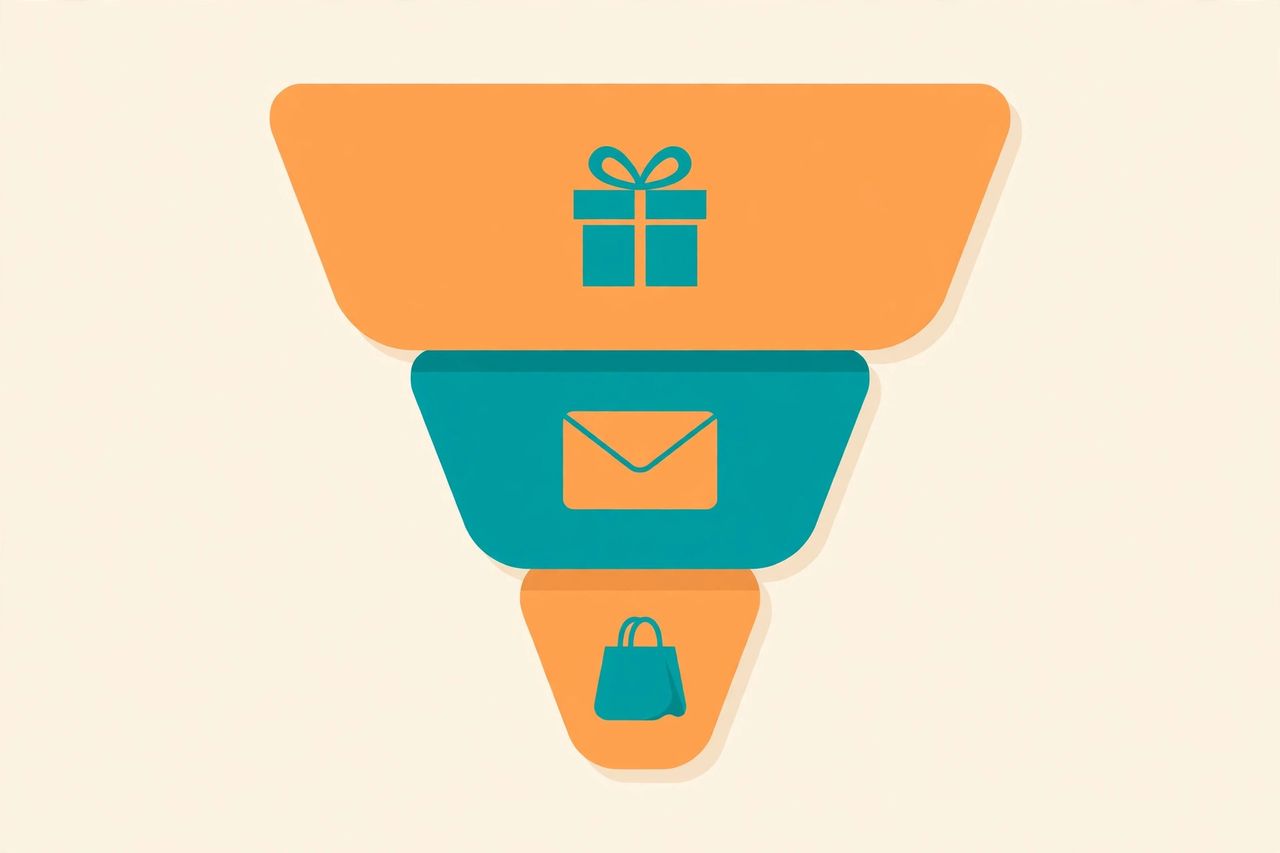
Most creators who sell digital products follow the same pattern: they build something good, post about it for two weeks, get a burst of sales, and then watch everything go quiet. So they build another product and start over. The problem is rarely the product. It is that there is no path between a stranger discovering your work and that person buying from you — no system that keeps working after the launch posts stop. A creator sales funnel is that path: a simple sequence that turns a free piece of value into an email subscriber, a subscriber into a first-time buyer, and a first-time buyer into a repeat customer.
This guide builds that funnel in five stages, with a worked example and realistic numbers at each step. You do not need a big audience to make it work. In fact, the funnel is what makes a small audience profitable: Kajabi's 2025 State of Creator Commerce survey of 1,717 creators found that six-figure creators averaged just 309 paying customers from an email list of about 4,000 subscribers. The funnel, not the follower count, did the work.
What a creator sales funnel actually is
A sales funnel is a fixed order of small yeses. A stranger will not buy your $97 course from a single social media post, but the same person will trade an email address for a useful free checklist. Once they have the checklist, a $9 mini-product feels like a small step. Once the $9 product works for them, the $97 course is the obvious next move. Each step is priced to earn the next yes, and the whole path runs on autopilot once it is built.
Think of it as a ladder, not a pitch. The classic mistake is skipping rungs — asking cold followers to buy the core product directly, then concluding that "my audience doesn't buy." They might buy; they were simply asked to jump too far. The funnel fixes the distance, not the audience.
The funnel also changes what your free content is for. Without a funnel, free content is just traffic — people read it and leave. With a funnel, every piece of free content has one job: move the right reader one step closer to your email list. That is the difference between creators who grow an audience and creators who grow a business.
Stage 1: the freebie that earns the email
The funnel starts with a lead magnet — a free resource valuable enough that someone will give you their email address for it. Three rules make one work. First, it must be specific: "10 AI prompts for project managers" will outperform a generic "AI prompts guide" because the right person recognises themselves immediately. Second, it must be usable within ten minutes — a one-page checklist or a plug-and-play template beats a 40-page ebook nobody reads. Third, it must preview your paid product: if your course is about YouTube scripting, a lead magnet about Instagram captions attracts the wrong people and breaks the funnel at the first step.
Match the freebie to what you sell. If you sell design templates, give away three templates from a larger collection. If you sell a course, offer a cheat sheet or mini-lesson covering one key concept. If you sell presets, share two or three sample presets from the full pack. The freebie is a sample, not a separate product — it should make the paid product feel like the natural next step.
Placement matters as much as the freebie itself. Put the opt-in form in three places at minimum: a dedicated landing page you can link to from anywhere, a contextual offer inside relevant blog posts, and a pop-up or slide-in that appears after about 30 seconds or 50% scroll — never the instant someone arrives. Keep the form to name and email only; every extra field drops conversions. A well-built landing page converts 20 to 40% of its visitors, while a blog pop-up typically converts 2 to 5% — so the landing page is where your best traffic should go.
Stage 2: the email bridge most creators skip
Here is where most creator funnels quietly die. A subscriber opts in for the checklist, receives it, and then gets a weekly newsletter and the occasional product announcement — but no deliberate path from "subscribed" to "bought." The list grows, revenue stays flat. The missing piece is the bridge: a short sequence of five to seven emails that fires automatically after every new opt-in, walking the subscriber toward a first purchase.
A simple bridge sequence looks like this. Email 1, immediately: deliver the freebie and say in two or three sentences what to expect next. Email 2, day 2: share one genuinely useful insight — proof that you know your subject, not a sales pitch — and end with a question that invites a reply. Email 3, day 5: tell a brief story about a specific result, yours or a customer's, with real numbers. Email 4, day 8: address the most common objection in your niche, the reason people hesitate. Email 5, day 11: introduce your low-priced offer as the natural next step from the free resource they already used.
Write these emails like you are writing to one person, not a list. Short paragraphs, conversational tone, and every email should deliver standalone value — if someone reads it and never buys, they should still feel it was worth opening. Kit's Email Marketing Stats Report found creator emails average a 44% open rate and a 3.7% click-through rate, which means a list of 1,000 produces roughly 16 clicks per send. That is the traffic your bridge converts, so the sequence deserves as much care as the product itself. Our guide to a creator's welcome email sequence covers the same seven-email shape in more detail, including what each email should and should not do.
Stage 3: the tripwire — the first small purchase
The tripwire is a low-priced product, typically $5 to $15, whose job is not revenue — it is identity. Once someone has paid you once, they are a fundamentally different kind of prospect, and the data backs that up: buyers are 60 to 70% more likely to purchase again than someone who has never bought. The tripwire turns a subscriber into a customer, and that single shift makes every later offer easier.
Price it so the decision is trivial. At $7 to $12, most people in your target audience can say yes without deliberation. Make it a natural upgrade from the freebie: a checklist becomes a detailed workbook, sample templates become a mini bundle of ten, a mini-lesson becomes a focused workshop recording. A typical tripwire converts 5 to 10% of subscribers, which sounds modest until you do the math — on a list of 1,000, that is 50 to 100 first-time buyers, and each one is now far more likely to buy your core product.
One warning: do not invent a fake discount. "Usually $29, yours for $9" only works if $29 is genuinely what you charge. Fabricated discounts erode exactly the trust the tripwire is supposed to build. Our guide to writing a sales page for a $9 product shows how to present a small offer honestly so it still converts.
Stage 4: the core product — where the real money is
Your core product is the main offer the whole funnel exists to sell, usually $25 to $100 or more. Do not rush this stage. A common mistake is pitching the core product before the subscriber trusts you enough to spend that much. After the bridge sequence and the tripwire, wait three to five days, then make the offer in a short sequence of two or three emails over a week: one introducing the product and the specific problem it solves, one addressing the top objections, and one final email with genuine urgency — a bonus that expires, or a direct "this is for you if" summary.
A well-built funnel typically converts 2 to 5% of email subscribers into core product buyers. That might sound low, but consider the math: 1,000 subscribers converting at 3% on a $49 product is $1,470 — and those subscribers accumulated passively through your lead magnet while you focused on other work. A detailed breakdown of this five-stage system, including the benchmarks at each step, is in this SendOwl guide to building a sales funnel for digital products.
The reverse math is even more encouraging. A $297 product at 1% conversion needs only about 1,700 engaged subscribers to generate $5,000 a month — the same break-even calculation that Kajabi's survey data supports, as explained in this creator funnel guide from free content to paid product. You do not need a huge list; you need a working funnel applied to a modest, engaged one.
Stage 5: upsells, cross-sells, and the second sale
The cheapest sale you will ever make is to someone who is already buying. At checkout, offer a higher-tier version or a complementary add-on — "you are getting the template pack, add the strategy workbook for 40% off." Effective upsells increase average order value by 10 to 30%, and even a modest 15% bump matters at scale: on a $49 product, that is an extra $7.35 per order, or $882 a year on just 120 orders.
Cross-sells work best in follow-up emails three to seven days after the purchase: "you bought the budget spreadsheet — our debt payoff tracker pairs perfectly with it." The key is relevance. If the connection between the products is not obvious to the buyer, do not force it — a pushy cross-sell costs more trust than it earns in revenue.
Do not forget cart abandonment. Between 60 and 80% of digital product carts are abandoned, and 15 to 20% of those are recoverable with three emails: a simple reminder after one hour, an objection-handling email with a small incentive after 24 hours, and a final reminder with a time-limited discount after 48 to 72 hours. Most abandoners did not decide against buying — they got interrupted. A gentle reminder at the right moment is often all it takes.
A worked example: the funnel in one niche
Take a creator who sells a $79 Notion template pack for freelance designers. Her freebie is three free invoice and client-tracking templates — the same system, sliced thin. Her bridge emails teach one invoicing mistake per email, with a real story about a late payment she recovered. Her tripwire is a $9 mini-bundle of ten more templates. Her core offer is the full $79 pack, introduced five days after the tripwire. At checkout she offers a $29 client onboarding workbook as an upsell.
With 2,000 subscribers, the numbers look like this: a 7% tripwire conversion gives 140 first-time buyers; a 3% core conversion gives 60 core buyers at $79, or $4,740; a 15% upsell take rate adds roughly $260 more. None of this required a viral post. It required a freebie, seven emails, and a checkout page — all built once and left running. The funnel also tells her exactly where to improve: if opt-ins are strong but tripwire sales are weak, the bridge sequence is the problem, not the product.
The mistakes that break a funnel
The first mistake is building the funnel backwards — starting with the core product and bolting on a freebie as an afterthought. Build it forwards: freebie first, then bridge, then tripwire, then core offer. The second mistake is a freebie that attracts the wrong people. A generic "productivity guide" will grow your list with people who will never buy a design template, and every later metric will look broken when the real problem is at the top.
The third mistake is silence after the opt-in. A subscriber who hears nothing for three weeks has forgotten who you are by the time the sales email arrives — that is why the bridge sequence must fire automatically, the same day, every time. The fourth mistake is pitching the core product in the first email. Trust is built in order, and skipping the order is the fastest way to burn a new subscriber. Finally, do not set the funnel up and never look at it again. Check the conversion rate at each stage monthly, and fix one stage at a time, starting from the top: fixing a leaky lead magnet improves everything below it, while fixing a weak upsell only affects the bottom.
One more thing the funnel depends on: an email list you actually own. Social media reach is rented — an algorithm change can halve it overnight — while an email list is an asset no platform can take away. If you are still deciding where to build your audience, our comparison of email list versus social media followers explains why the list comes first.
Build your funnel in four weeks
Week 1: create the lead magnet and the first two bridge emails, and set up a free email service — Kit, MailerLite, or Mailchimp all have free tiers that cover the basics. Week 2: finish the bridge sequence, create the tripwire product, and set up automated delivery. Week 3: write the core product email sequence and make sure your store page is ready. Week 4: add cart abandonment emails, then test the whole path yourself — opt in with a fresh email, buy the tripwire, and check that every email arrives and every link works.
That is one month of focused work for a system that keeps selling while you make your next video or write your next post. Start with the freebie this week. Everything else in the funnel is just the next small yes.
Frequently asked questions
How many email subscribers do I need before building a funnel?
None. Build the funnel first, even with zero subscribers — the lead magnet and bridge sequence are what grow the list in the first place. Waiting for a big list before building the funnel is backwards; the funnel is the machine that turns traffic into subscribers and subscribers into buyers.
Do I need paid tools to build a creator sales funnel?
No. A free email service, a simple landing page, and a digital product platform with a free tier are enough to get the first version live. Paid tools help when your volume grows — for example, if you want advanced automation or detailed analytics — but they are not a requirement.
What should my tripwire cost?
Between $5 and $15 for most niches, with $7 to $12 as the sweet spot. It should feel like an impulse purchase, not a decision. If your core product is expensive — say, $297 — a slightly higher tripwire of $27 to $47 can still work, because the gap between the tripwire and the core product is what matters, not the absolute price.
How long does it take for a funnel to start making sales?
The first sales usually come within the first two to three weeks of the funnel going live, once the bridge sequence has run for a few new subscribers. But the real payoff is cumulative: the list grows every week, the sequence keeps running, and the revenue compounds. Judge the funnel after 60 to 90 days, not after the first week.
Conclusion
A creator sales funnel is not a marketing trick; it is the infrastructure that turns attention into income. One freebie, a short email bridge, a small first purchase, and a core offer — each step earning the next yes — is enough to make a modest audience profitable. You do not need ten thousand subscribers or a viral moment. You need a path, built once, that works while you are busy creating. Build the freebie this week, wire the emails next week, and let the funnel do the selling you have been doing by hand.
Related Marketplace Assets
AI CTA Generator
Craft clear, persuasive calls-to-action tailored for newsletters, digital downloads, video outros, and community growth.
AI Product Description Generator
Generate persuasive, structured sales descriptions for digital products, templates, and courses that convert visitors.
AI Creator Email & Newsletter Writer
Draft personal, high-engagement broadcast emails and newsletter editions with curiosity subject lines and clear CTAs.