How to Grow on Instagram Reels in 2026: Watch Time, Shares and a System That Compounds
Reels now eat half of all time spent on Instagram, yet most creators stay stuck at a few hundred views. This guide covers the four signals the algorithm actually weighs in 2026, the cold-start test, hooks, length, and a weekly system that compounds.
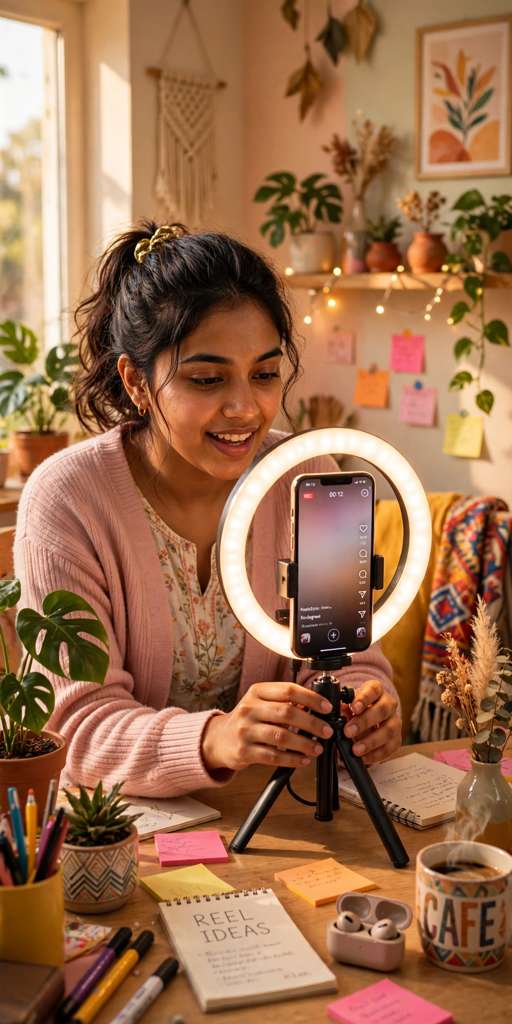
Instagram Reels now eat half of all the time people spend inside the app, and the platform pushes them to non-followers far harder than it pushes static posts. That should make Reels the easiest growth lever a creator has. Yet most creators post Reels for months and stay stuck at a few hundred views, while a smaller account with the same niche quietly passes them. The difference is rarely talent or equipment. It is that the smaller account is playing by the ranking rules Instagram actually uses in 2026, and the stuck account is still playing by the rules of 2022.
This guide covers how to grow on Instagram Reels in 2026: the four signals the algorithm actually weighs, the cold-start test every Reel faces in its first hour, the length and hook rules that decide whether a Reel gets shown to strangers, and a weekly system you can sustain without burning out. Everything here is grounded in what Instagram and Meta have said publicly and in current reporting from independent guides — not in growth hacks that stopped working years ago.
How the Reels algorithm actually ranks in 2026
Instagram does not run one algorithm. It runs separate ranking systems for Feed, Reels, Stories and Explore, and the Reels system leans hardest on two questions: do people keep watching, and do they share it with someone else? Adam Mosseri has confirmed the three signals that decide reach, in this order: watch time, sends per reach (DM shares), and likes per reach. Saves and replays sit just behind them as strong supporting signals.
| Signal | What it tells Instagram | What to do about it |
|---|---|---|
| Watch time | The single most important factor. Completions and rewatches say the Reel is worth promoting. | Cut slow intros. Earn the next second, every second. |
| Sends per reach | DM shares are the loudest positive vote and the strongest lever for reaching non-followers. | Make Reels worth sending to a friend or saving for later. |
| Likes per reach | Still counts, but carries less weight, and matters more for existing followers. | Treat likes as a bonus, not the target. |
| Saves | Lasting value. Educational and reference content earns them, weighted well above likes. | Pack one genuinely useful idea into each Reel. |
| Replays | One watch was not enough to catch everything — a powerful quality signal. | Make dense, information-rich Reels that reward a second viewing. |
Two things follow from this table that change how you should make Reels. First, follower count is not the ranking factor you think it is. A 15-second Reel watched three times by strangers outranks a 60-second Reel watched once by your followers, because total watch time and replays are what the system measures. Second, the like count on your screen is the least informative number you can stare at. Shares and saves are the numbers that predict whether Instagram will show your next Reel to people who have never heard of you.
The cold-start test every Reel faces
Every Reel starts the same way: Instagram shows it to a small pool of non-followers first, then watches what happens in the first 30 to 60 minutes. Strong early watch time and engagement velocity tell the system to widen the audience. Weak signals, and the Reel quietly stalls — it is not shadowbanned, it simply failed its audition.
This is why the opening seconds and the first hour matter so much, and why posting and disappearing is the worst possible habit. When a Reel goes live, stay around for the first hour: reply to early comments, answer DMs, and share the Reel to your Story so your existing audience gives it its first push. A Reel that gets its first saves and shares from people who already follow you has a much better chance of passing the cold-start test with strangers than one that sits untouched for six hours.
It is also why Trial Reels have become one of the most useful tactics of 2026. You can publish a Reel to non-followers only, gather real performance data over roughly a day, and then decide whether to share it with your followers. If it performs, Instagram can push it wider or you release it with one tap. If it flops, it simply disappears, with no drag on your profile's average engagement. Think of it as a free focus group before you risk your follower signal on a bold new format or hook.
Hooks: win the first three seconds or lose the scroll
Instagram counts a view at three seconds, and viewers decide whether to keep watching in even less time than that — under three seconds, often closer to one and a half. Your hook is not your intro. It is the payoff, the surprising result, the bold specific claim, or the exact question your audience is already asking. "Here is why your Reels stop at 200 views" beats "Hey guys, welcome back to my channel" every single time.
Put the hook in on-screen text as well as in speech, because most people scroll with the sound off. Open with the result first and explain afterwards: show the finished dish, the before-and-after, the number, the mistake — then walk backwards into how it happened. Skip logos, skip "in today's video", skip the slow pan of your desk. Every second before the point is a second in which someone can swipe away, and a swipe in the first three seconds is the most expensive signal your Reel can send.
A practical test before you post: watch your Reel on mute, with the sound off, and ask whether a stranger would understand the promise in the first two seconds. If not, the hook is not on screen yet. Re-record the opening, do not just add a caption and hope.
How long should a Reel be?
Instagram now allows Reels of up to 20 minutes recorded in-app, but it does not recommend Reels longer than 3 minutes to new audiences, according to Sprout Social's November 2026 specs guide. For reach, most Reels should run 15 to 60 seconds and end as soon as the point is made. Independent guides that track performance across accounts put the sweet spot for completion and replays at 7 to 45 seconds: long enough to land one clear idea, short enough that people finish and watch again.
The rule is simple: use the shortest length that delivers your one idea. A 14-second Reel watched twice will usually beat a 60-second Reel most people abandon halfway. Longer Reels can reach non-followers now — Reels up to 3 minutes can surface on Explore — but only if retention holds for the whole length. If your Reel needs 90 seconds, earn every one of them; if it needs 20, do not stretch it to 60 because a guide told you longer is better. It is not. Completion is better.
One idea per Reel is a discipline, not a limitation. A Reel that tries to teach five things teaches none of them well enough to earn a save. Pick the single most useful point, deliver it completely, and let the next Reel carry the next point. Your audience will follow a series; they will not rewatch a ramble.
Design every Reel to be sent, not just liked
Private sharing is how much content spreads now. Social media analyst Lia Haberman, quoted by Sprout Social, put it plainly: DMs, not the Feed, Stories or Broadcast Channels, are the primary way people share on Instagram. Reels get reshared through DMs billions of times a day. That makes "would someone send this to a friend?" the single most useful question to ask before you post.
Relatable humour, genuinely useful tips, and "tag someone who needs this" prompts earn DM shares. So do checklists, surprising facts, and anything that solves a problem a friend has right now. A Reel that says "send this to a friend who keeps making this mistake" gives the viewer a social reason to share, not just a content reason. Build a "send this" moment into every Reel — a line, a comparison, or a payoff that only works if someone else sees it too.
Saves work the same way for a different reason. A save says "I intend to come back to this", and Instagram reads it as lasting value. Educational and how-to Reels earn saves; entertainment Reels earn shares. If your niche is teaching, lean into saves with dense, reference-style Reels and an explicit "save this for later" call to action. If your niche is entertainment, lean into shares. Either way, pick one job per Reel and design for it, instead of hoping a single Reel does everything.
Originality rules in 2026: what will quietly kill your reach
Instagram's 2026 originality rules reward fresh creative and demote near-duplicates. Reposting a watermarked clip — a visible TikTok or CapCut logo — can tank your reach, and the originality policy now extends to carousels too. Borrow the sound, not the idea: trending audio still gives a discovery boost, but a Reel that is a near-copy of someone else's will be demoted even if the audio is trending.
The sharpest version of this rule is about reposts. Accounts that post 10 or more reposts in a 30-day window get pulled from recommendations entirely, according to current reporting on Instagram's 2026 rules. That means a feed full of reshared clips is not a growth strategy, it is a distribution penalty. Shoot and edit for Instagram, add your own angle when you cover a trend, and rework your own ideas rather than copying someone else's.
The same honesty applies to growth shortcuts. Buying followers inflates your count while destroying your watch time and sends per reach — the exact signals the algorithm uses to decide whether to show your Reels to strangers. A small account with a high share rate can land on Explore while a big, sleepy account stays invisible. If you are choosing between a shortcut and a system, choose the system; the algorithm can tell the difference even when your friends cannot.
Captions are search signals now, not hashtag bins
Instagram increasingly behaves like a search and interest engine, so keyword-led captions and on-screen text help it understand and recommend your Reel. Describe what the Reel is actually about in plain language, using the words your audience would type into search. Put the key phrase in the caption's first line, in your name field, and in your bio — those are searchable fields, and nearly one in three consumers now use social media for search instead of traditional search engines, according to Sprout Social's Q2 2025 Pulse Survey.
Hashtags still help label content, but they are a minor factor next to watch time, shares and freshness. Use three to five specific, relevant hashtags as topic signals, then stop. The keywords in your caption and on-screen text do the heavy lifting now. A caption that reads like a real sentence about a real problem will outperform a block of 30 hashtags every time, because it tells both the algorithm and the human reader what they are about to watch.
Caption every video, too. Captions and on-screen text make the message land without sound, make your content accessible to people who are deaf or hard of hearing, and help viewers who are skimming the feed. Correct auto-captions for names, numbers and industry terms — a wrong number in a caption is worse than no caption at all.
A weekly system that compounds instead of burning you out
Growth on Reels is a compounding game, and compounding needs a rhythm you can keep for months. Meta has said same-day posts make up more than 30% of recommended Reels on Instagram and Facebook, more than double the level a year earlier — recency counts, and a steady rhythm of two to four Reels a week usually beats occasional bursts. Around three to four Reels a week is the sweet spot most guides land on: enough data to learn from, not so much that quality slips. Sprout Social's Q1 2026 Pulse Survey found 66% of users are more selective about what they engage with than a year earlier, so posting more than you can keep good will cost you reach, not buy it.
A workable week for a solo creator looks like this. Monday: plan three Reels around real audience questions — one tutorial, one relatable or entertaining Reel, one opinion or behind-the-scenes Reel. Tuesday and Thursday: film and post, writing the hook first and the rest afterwards. Wednesday: one carousel for depth and saves, since carousels consistently earn higher engagement than Reels while Reels earn nearly twice as many comments as static images. Every day: Stories for the people who already follow you, with polls, questions and links that move them toward a next step. Reels reach new people; Stories keep existing followers engaged. They are different jobs, and both matter.
When a Reel starts performing, post your next one quickly. The surge of profile visits from a hit Reel primes your next upload for a stronger start, because the cold-start test begins with an audience that is already warm. Virality is rarely one lucky video. It is usually a good Reel landing on an audience that a previous Reel warmed up.
If you are deciding where Reels fit beside your other short-form work, our comparison of YouTube Shorts vs Instagram Reels in 2026 breaks down which format fits which goal for Indian creators. And if Reels start driving sales rather than just views, our guide to selling on Instagram without a website shows how to turn that attention into orders. The same discipline — pick the surface the platform rewards, post there consistently — runs through our other platform guides too, from growing on Threads in 2026 to growing on Facebook as a creator.
Mistakes that stall Reels growth
Most stalled Reels accounts share the same few mistakes. The first is the slow opening: a logo, a greeting, a pan of the room. The viewer is gone before the point arrives. The second is the watermarked repost — a TikTok clip uploaded as-is, which the originality rules demote. The third is posting in bursts: ten Reels in a weekend, then silence for three weeks. Instagram rewards a steady habit, and its audience forgets fast.
The fourth mistake is ignoring the first hour. A Reel posted and abandoned gets no early saves or shares, fails its cold-start test, and stalls at 200 views — and the creator concludes the algorithm hates them, when the Reel simply had no one in the room to vouch for it. The fifth is chasing every trend without adding an angle. Trends give you borrowed reach; your angle is what earns the follow. The sixth is measuring the wrong number: celebrating likes while saves, sends and non-follower reach stay flat. Likes lag behind; watch time, shares and saves predict reach.
Finally, do not copy another creator's Reel shot for shot and expect the same result. The originality rules demote near-duplicates, and even when they do not, the audience has already seen the idea — from the person who made it first. Your version needs your angle, your example, your voice. That is the part no one can copy from you.
What to measure every week
Check these numbers for every Reel, once a week, and compare formats over a month. The pattern will tell you what to make more of — and it will be specific to your audience, not to a generic guide.
| Metric | What it tells you |
|---|---|
| Average watch time / completion rate | Whether your hook and pacing hold attention — the core ranking signal. |
| Reach from non-followers | How well the cold-start test is going; your true growth engine. |
| Sends | Shareability, the strongest lever for new-audience reach. |
| Saves | Lasting value; a strong vote of content quality. |
| Profile visits | Whether Reels make people curious about who you are. |
| Link clicks / conversions | Whether reach actually turns into business results. |
Review weekly, compare formats over a month, and remake your best performers with new hooks. A Reel that worked once is a format, not a fluke: the same idea with a stronger opening, a tighter cut, or a different example is a new Reel that the algorithm has already told you people want. That is how small accounts compound — not by going viral once, but by repeating what worked with small improvements, week after week.
Two independent guides corroborate the numbers and rules in this article: the detailed Instagram reach guide on Express Digital, published 16 November 2026 and grounded in what Instagram and Meta have said publicly plus DataReportal and Sprout Social data, and the Reels marketing strategies guide on IKF, which tracks the same ranking signals — watch time first, sends per reach second, likes per reach third — across its client accounts through 2026.
Frequently asked questions
How many Reels should I post per week to grow?
Three to four Reels a week is the sweet spot for most creators: enough to stay fresh in recommendations and gather data, not so many that quality slips. Meta has said same-day posts make up more than 30% of recommended Reels, so a steady rhythm beats occasional bursts. Post as often as you can while keeping every Reel good.
What is the best length for an Instagram Reel in 2026?
For reach, 15 to 60 seconds, with 7 to 45 seconds the sweet spot for completion and replays. Instagram does not recommend Reels longer than 3 minutes to new audiences, even though in-app recording allows up to 20 minutes. Use the shortest length that delivers your one idea.
Do hashtags still help Reels grow?
They help label content, but they are a minor factor next to watch time, shares and freshness. Use three to five specific, relevant hashtags, and put more effort into keyword-led captions and on-screen text, since Instagram now behaves like a search engine. A caption that describes the Reel in plain words does more than a block of 30 hashtags.
Why are my Reels stuck at 200 views?
Most often, the Reel failed its cold-start test: weak watch time in the first hour, few saves or shares, or a slow opening that lost viewers before three seconds. Check your average watch time and your sends per reach, tighten the hook, and stay active in the first hour after posting. Also check for reposted or watermarked content — 10 or more reposts in 30 days can pull an account from recommendations entirely.
Conclusion
Growing on Instagram Reels in 2026 comes down to a simple loop: hook fast, hold attention, earn the share, and stay consistent. Watch time decides whether Instagram shows your Reel to strangers, sends per reach decide how far it travels, and saves decide whether it keeps working after the first day. None of that needs a budget, a team, or a viral moment. It needs one good idea per Reel, an opening that earns the next three seconds, and a weekly rhythm you can keep for 90 days. Start with the Reel you already know how to make, fix its first three seconds, give it a reason to be sent to a friend — and then make the next one a little better.
Related Marketplace Assets
AI Instagram Caption Generator
Generate 3 distinct styles of engaging Instagram captions with hooks, emojis, and conversation-starting CTAs.
AI Smart Hashtag Generator
Discover targeted, tiered hashtag groups categorized into broad high-reach, niche-specific, and community tags.
AI Social Media Post Generator
Generate engaging, platform-aware social media posts formatted with clean spacing, strong hooks, and closing prompts.