YouTube Shorts vs Instagram Reels in 2026: Which One Should Indian Creators Choose?
They look identical — vertical video, full screen, swipe up. But Shorts and Reels run on different algorithms, pay creators differently, and keep videos alive for very different lengths of time. Here is how to choose the right one for your content, your audience and your income goal.
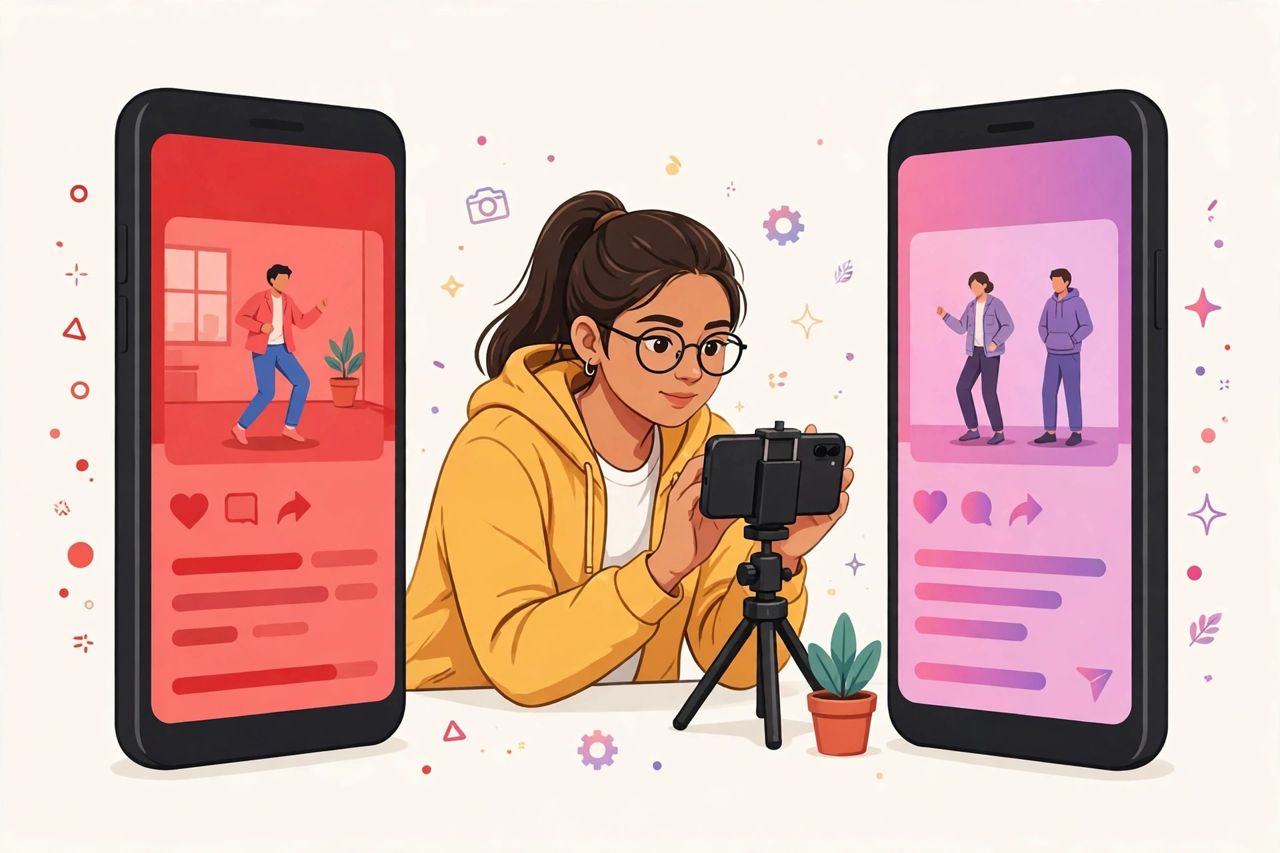
Open YouTube Shorts and Instagram Reels side by side and they look like the same product: vertical video, full screen, swipe up for the next one. A creator could be forgiven for thinking the choice between them does not matter — just post the same clip everywhere and see what sticks. But underneath the identical format sit two very different businesses, and that difference decides who sees your video, how long it keeps working, and whether it ever pays you anything.
This is not a contest with one winner. YouTube Shorts vs Instagram Reels is a question about fit: what you make, who it is for, and what you want it to do for you. A tutorial creator, a fashion seller and a brand-new account with zero followers will get three different answers. This guide compares the two platforms on the things that actually change a creator's results in 2026 — the algorithm, discovery for small accounts, money, audience, and how long a video keeps earning views — so you can decide where your next hour of effort should go.
YouTube Shorts vs Instagram Reels at a Glance
| YouTube Shorts | Instagram Reels | |
|---|---|---|
| Maximum length | 3 minutes | 3 minutes |
| How discovery starts | Shown to strangers first, then expanded on performance | Shown to your followers first, then expanded to non-followers |
| Direct pay per view | Yes — YouTube Partner Program, 45% revenue share | No stable per-view payment; invite-only bonuses |
| Search visibility | Strong — Shorts appear in Google Search and AI answers | Mostly inside Instagram only |
| Content lifespan | Weeks to months | Days to weeks |
| Commerce | Brand links and shopping features still maturing | Mature Instagram Shopping, product tags, in-app checkout |
| Best for | Long-term growth, searchable tutorials, building a channel | Brand deals, lifestyle content, selling products |
Both caps now sit at three minutes — YouTube raised the Shorts limit from 60 seconds in October 2024 — so length is no longer the deciding factor. What matters is everything around the video.
How the Algorithms Actually Differ
The single biggest difference is what happens in the first hour after you publish. YouTube Shorts runs what is essentially an explore-and-exploit loop aimed at strangers. Your Short is shown to a small test audience that does not necessarily follow you. YouTube watches what those viewers do — do they swipe away in two seconds, watch to the end, like, share, subscribe after watching — and either expands distribution or lets the video fade. Your subscriber count barely matters in that first test.
Instagram Reels works the other way around. Distribution starts with a slice of your existing followers in their feed and the Reels tab. The algorithm watches saves, shares to friends over DM, and watch-through rate. Only if those early signals clear a threshold does the Reel expand to non-followers through Explore. The share-to-friend rate is, by Meta's own public description of its recommendation system, the strongest predictor of whether a Reel keeps travelling.
The practical consequence is counter-intuitive: Shorts is friendlier to a brand-new account than Reels is. A new YouTube channel can have a Short reach 100,000 views in its first week because the algorithm does not penalise it for having no subscribers. A new Instagram account posting Reels usually hits a soft ceiling until it builds enough follower engagement to pass that first phase. If you are starting from zero, Shorts gives your good content a faster shot. If you already have an engaged Instagram community, Reels compounds off it in ways Shorts cannot.
Reach and Discovery for a New Creator
The numbers behind that difference are striking. According to 2026 benchmarks, roughly 74% of Shorts views come from people who do not subscribe to the channel — the highest non-follower share of any major platform. Small creators with 1,000 to 5,000 subscribers average around 2,600 views per Short. On Instagram, Reels achieves an average reach rate of about 30.81% — the highest of any Instagram format, well above static posts and carousels — but around 55% of Reel views still come from non-followers, with the rest depending on your existing community.
There is also a structural detail that matters more than most creators realise: Shorts and long-form videos live in separate recommendation systems inside YouTube. A poorly performing Short does not hurt your long-form channel, and a long-form flop does not drag down your Shorts. That separation makes Shorts a genuinely low-risk testing surface. You can try formats your long-form audience would hate, and your long-form viewership will not drop. Reels has no such separation — everything you post feeds the same account-level signals.
None of this means Reels cannot deliver reach. Trend-driven Reels, especially ones that adopt a trending audio early, can explode within days because Instagram pushes trend participation hard. The difference is the shape of the curve: Reels spikes fast and fades fast, while Shorts builds more slowly and keeps delivering.
The Money Question: What Each Platform Actually Pays
This is where the gap between the platforms is widest, and it is the part most creator advice skips. YouTube pays Shorts creators through the YouTube Partner Program. The full eligibility bar is 1,000 subscribers plus either 4,000 watch hours in the last 12 months or 10 million qualified Shorts views in the last 90 days, as listed on YouTube's official Partner Program page. Once you are in, creators receive 45% of the ad revenue allocated to Shorts. Industry benchmarks put Shorts RPM — revenue per 1,000 views — at roughly $0.01 to $0.07, so a million Shorts views pays in the region of $10 to $70 directly.
That sounds small, and on its own it is. The real YouTube monetization advantage is the ecosystem around the Short. Shorts funnel viewers into long-form videos, where CPMs commonly reach $5 to $20 or more depending on the niche, and where channel memberships, Super Thanks, affiliate links and sponsorships layer on top. A Short that brings a viewer to a long-form video they watch for years is worth far more than the few cents of Shorts ad revenue it generated. If you want the full picture of what Shorts pays, our guide to YouTube Shorts monetization in 2026 breaks down the requirements, RPM and realistic earnings for Indian creators in detail.
Instagram has no equivalent stable payment. The Reels Play Bonus program, which once paid creators per view, has been scaled back repeatedly and now operates as a sporadic, invitation-only bonus rather than a dependable revenue stream. What Reels does offer is a larger and higher-paying brand-deal market in most niches — lifestyle, beauty and fashion brands spend heavily on Instagram — plus mature shopping tools. A creator with a product to sell can earn more from one Reel with a product tag than from a million Shorts views. The honest summary: YouTube pays best per view and over the long term; Instagram converts best commercially, right now, for creators whose audience buys things.
Audience: Who Is Watching on Each Side
Both platforms report around 2 billion monthly users, and the 25–34 age group is the largest on both. The differences are in the mix. India is the top geography for YouTube Shorts, which matters a lot if your content is in Hindi, Hinglish or aimed at Indian viewers. Instagram's audience skews slightly female in the US and is concentrated in the 18–44 band, with the 35–44 segment growing fastest as the platform ages into B2B-viable territory.
Audience intent differs too. People open YouTube with a question in mind — how to do something, what happened, whether something is worth buying — and Shorts inherit that search-driven mindset. People open Instagram to see what their friends and favourite creators are doing, and Reels inherit that social, trend-driven mindset. That is why the same topic performs differently: a "how to file ITR" Short can keep getting views from search for months, while a trending-audio Reel about the same subject would feel out of place. The audience you want should shape the platform you pick, not the other way around.
How Long a Video Keeps Working
Content lifespan is the quiet advantage that compounds over years. Shorts appear in Google Search results — the only short-form format with strong Google indexation — and AI assistants increasingly cite YouTube content in their answers. A Short on a high-volume search topic can drive views for 6 to 12 months after publishing through search alone, and YouTube's own search keeps surfacing it through transcripts and captions. Reels, by contrast, are largely invisible outside Instagram. Google rarely surfaces them, AI assistants rarely cite them, and discovery happens almost entirely inside the app. A Reel that does well gets its views in days or weeks, then stops.
For a creator thinking in a three-year horizon, that compound effect often justifies prioritising Shorts even when Reels would win the first 30 days. A back catalogue of searchable Shorts is an asset that keeps paying in subscribers and long-form views. A back catalogue of Reels is mostly a portfolio — useful for brand deals, but not a traffic engine. The detailed numbers behind this comparison are laid out well in the 2026 Shorts vs Reels comparison, which tracks the discovery and revenue data across both platforms.
What Content Wins on Each Platform
The algorithm rewards different things, so the same clip rarely performs equally on both. On Shorts, value density wins: a clear hook in the first two seconds, one idea per video, and a payoff that makes the viewer glad they stayed. Tutorials, explainers, comparisons, quick how-tos and honest reviews do well because they match search intent and reward re-watches. On Reels, trend participation and visual polish win: trending audio used early, aesthetic framing, relatable humour, and content that people want to share with a friend over DM. Shopping-led content — try-ons, product demos, before-and-after transformations — converts far better as a Reel because the checkout is one tap away.
That does not mean you must make two completely different kinds of video. It means the same idea needs a different edit: a tighter, information-first cut for Shorts, and a trend-aware, shareable cut for Reels. The creators who struggle most are the ones who upload the identical file to both and wonder why one flops. Small adaptations — the hook, the caption, the audio choice — are usually the difference.
Posting to Both Without Hurting Either
For most creators, the right answer is not to choose one platform but to run both with a clear priority. The practical workflow is simple: shoot once, edit twice. Keep the raw footage, then cut a Shorts version and a Reels version with different hooks and captions. Upload natively to each app rather than reposting with the other platform's watermark — both algorithms deprioritise watermarked re-uploads. Use each platform's own scheduling or a scheduler that posts natively, and announce new videos where your audience already is — a YouTube Community post reaches subscribers between uploads, and an Instagram Story does the same job on the other side.
The 80/20 rule works well here: give 80% of your short-form effort to the platform that matches your main goal, and 20% to the other one as a second net. A creator building a YouTube channel puts Shorts first and cross-posts to Reels. A creator selling products puts Reels first and cross-posts to Shorts. Either way, you keep a presence on both without doubling your workload — and if one platform changes its rules, you are not starting from zero on the other.
So, Which One Should You Choose?
Choose YouTube Shorts first if you are starting from zero, if your content teaches or answers questions, if you want views that compound for months, or if your long-term plan includes long-form videos, a channel, or search traffic. Choose Instagram Reels first if you already have an Instagram following, if you sell products or work with brands in lifestyle, beauty or fashion, if your content is trend-driven and visual, or if your audience already lives on Instagram. Choose both, with a clear priority, if you can afford the extra editing time — because the two platforms reach different people in different mindsets, and the same idea can earn twice.
What not to do is pick a platform because someone else is winning on it. A creator with 100,000 Instagram followers will tell you Reels is better; a creator with a million-view Short will tell you Shorts is better. Both are describing their own situation, not yours. Look at your content, your audience and your income goal, and the answer is usually obvious.
Mistakes Creators Make When Choosing
The first mistake is judging a platform by its first week. Reels often look better in week one because of the fast spike; Shorts often look better in month three because of the long tail. Comparing them after seven days is like comparing a sprinter and a marathon runner after the first hundred metres.
The second mistake is copying the format without copying the intent. A Short that is just a Reel with the Instagram watermark cropped out will underperform, and a Reel that is just a Short re-uploaded will too. Each platform's audience can tell when a video was made for somewhere else.
The third mistake is chasing monetization before audience. The YPP thresholds and the brand-deal market both reward creators who already have attention. Picking a platform for its payout before you have an audience is backwards — pick the platform where your content can actually find its first thousand viewers, and the money follows the audience.
Frequently Asked Questions
Can I post the same video on YouTube Shorts and Instagram Reels?
Yes, and most creators do. Upload natively to each app without the other platform's watermark, and adapt the hook and caption for each audience. The same raw footage can become two different edits.
Which pays more, YouTube Shorts or Instagram Reels?
For direct per-view payment, Shorts pays more — creators get 45% of Shorts ad revenue through the YouTube Partner Program, while Reels has no stable per-view payment. For brand deals and product sales, Reels often earns more, because its shopping tools and brand market are stronger.
Do I need 1,000 subscribers to earn from Shorts?
For full Partner Program access, yes — 1,000 subscribers plus either 4,000 watch hours or 10 million Shorts views in 90 days. There is also a lower entry tier with 500 subscribers and 3 million Shorts views that unlocks limited monetization features such as memberships and Super Thanks.
Is Instagram Reels or YouTube Shorts better for beginners?
Shorts is usually better for a brand-new creator, because its algorithm tests videos on strangers first and does not depend on an existing follower base. Reels works better once you already have an engaged Instagram audience to give your videos their first push.
Conclusion
YouTube Shorts and Instagram Reels are not two versions of the same thing. Shorts is a discovery and search engine that rewards new creators, compounds over months, and pays through an ecosystem that leads to long-form revenue. Reels is a social and commerce engine that rewards existing communities, converts attention into sales and brand deals, and spikes fast on trends. The creators who do best in 2026 are not the ones who picked the "right" platform — they are the ones who understood what each platform actually does, chose the one that matches their goal, and used the other one as a second net. Start with the platform that fits your content and your audience today, post to both when you can, and let the results — measured over months, not days — tell you where to put your next hour.
Related Marketplace Assets
AI YouTube Title Generator
Generate curiosity-driven, high-converting video and article title variations engineered to capture viewer interest.
AI YouTube Description Generator
Craft structured YouTube video descriptions featuring above-the-fold hooks, key timestamps, and clear calls to action.
AI YouTube Script Generator
Generate comprehensive, high-retention YouTube video scripts with visual B-roll cues, pacing markers, and outro CTAs.