YouTube Shorts Monetization in 2026: Requirements, RPM and Realistic Earnings for Indian Creators
YouTube Shorts monetization pays in cents per thousand views by design. This guide covers the 2026 YPP requirements, the shared revenue pool, realistic RPM for Indian creators, and the seven income streams that matter more than ad revenue.
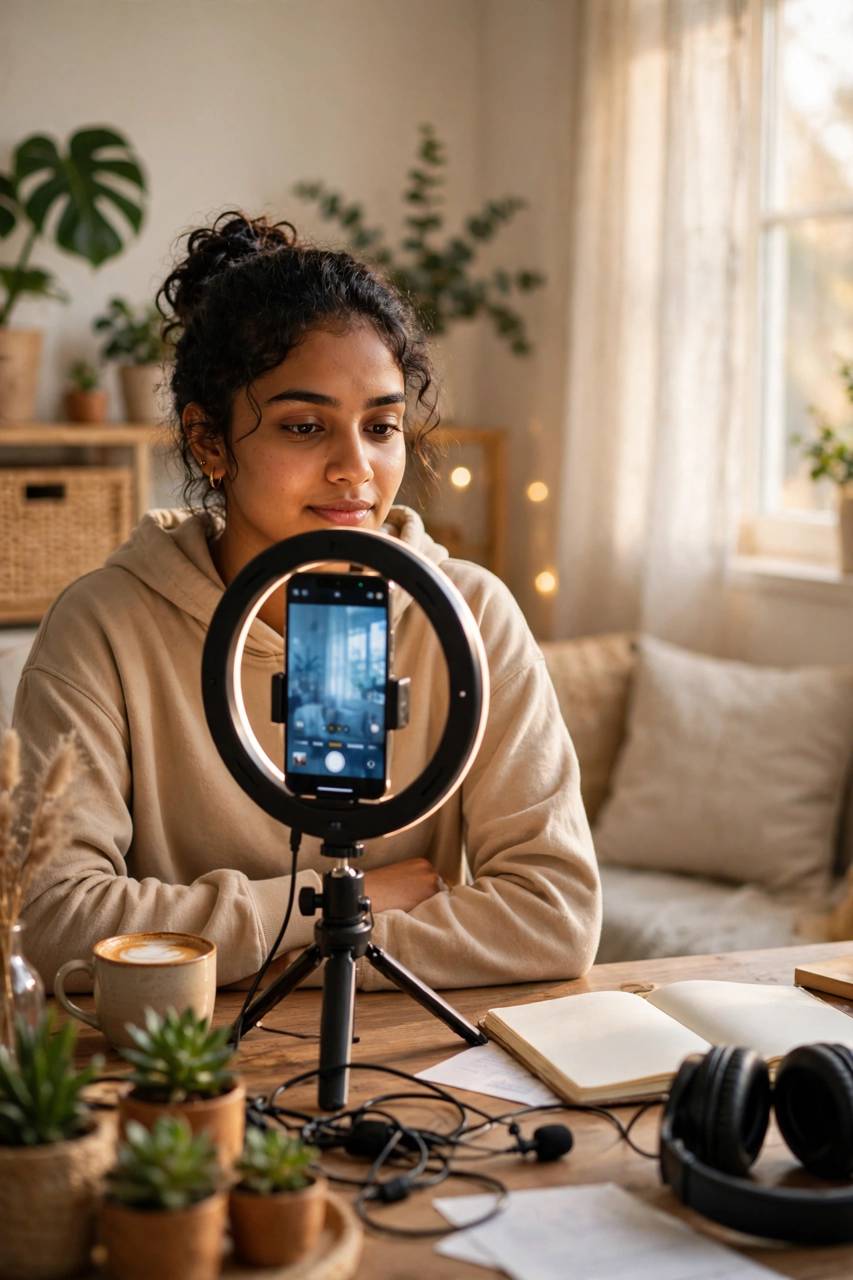
A Short with a million views sounds like a payday. For many Indian creators it is the first video that ever crosses seven figures — and then the YouTube Studio earnings page shows a number so small it feels like a mistake. It is not a mistake. YouTube Shorts monetization works on completely different maths from long-form video, and creators who understand that maths early make far better decisions than creators who chase views and hope the money follows.
This guide explains YouTube Shorts monetization as it actually works in 2026: the eligibility rules, how the shared revenue pool pays you, what RPM Indian creators realistically earn, and the income streams that matter far more than ad revenue alone.
How YouTube Shorts Monetization Actually Works
Long-form videos earn money from the ads shown on that specific video. Shorts do not work that way. There is no ad attached to your Short that pays you directly. Instead, YouTube pools all the money advertisers pay for ads shown between Shorts in the feed, then shares that pool among monetized creators.
The process has four steps. First, YouTube collects all Shorts feed ad revenue. Second, it calculates the creator pool — the share of that money set aside for creators, which depends on total Shorts views and on how much licensed music was used across the platform. If a Short uses no licensed music, its share stays whole; if it uses a commercial song, part of the money goes to music publishers before creators see any of it. Third, the pool is divided among creators according to each creator's share of total Shorts views. Fourth, creators keep 45% of their allocated share, and YouTube keeps 55%.
Two consequences follow from this design. Your earnings depend not only on your own views but on the size of the whole pool that month, which rises and falls with advertiser spending. And the views that count are engaged views — real views from real people. Since 31 March 2025, the public view counter on a Short counts every start and replay, but YouTube pays only on engaged views. Bot traffic, purchased views, reuploaded clips and policy-violating content are classified as ineligible and removed from the pool entirely.
YouTube Shorts Monetization Requirements in 2026
Shorts earnings come through the YouTube Partner Program (YPP), the same programme as long-form monetization. You need to meet only one of two thresholds:
The Shorts path: 1,000 subscribers plus 10 million valid public Shorts views in the last 90 days. The long-form path: 1,000 subscribers plus 4,000 valid public watch hours from long-form videos in the last 12 months. Meeting either one makes you eligible for the full programme, including Shorts ad revenue. Shorts watch time does not count towards the 4,000 watch hours, so the two paths are genuinely separate.
There is also a lower entry tier. With 500 subscribers, 3 public uploads in the last 90 days, and either 3 million Shorts views in 90 days or 3,000 watch hours, you unlock fan-funding features — Super Thanks, Super Stickers, channel memberships and YouTube Shopping. That tier does not include ad revenue. For ads, the full 1,000-subscriber threshold still applies.
One change deserves attention now, not later. vidIQ's 2026 Shorts monetization guide notes that from 1 February 2027 the thresholds rise to 8,000 qualified watch hours or 20 million qualified Shorts views, with the 1,000-subscriber requirement unchanged. If you are building towards eligibility, plan for the higher bar — a channel that reaches 10 million views in January 2027 but applies in February will find the goalposts moved. India is on YouTube's list of supported countries for YPP, so Indian creators can apply once they qualify, provided the channel has no active Community Guidelines strikes, 2-Step Verification switched on, and a linked AdSense for YouTube account. Review usually takes one to four weeks.
What RPM Really Means — and What Indian Creators Actually Earn
RPM means revenue per 1,000 views, after YouTube's cut. For Shorts, most creators earn between $0.03 and $0.10 per 1,000 views, with finance, tech and US-heavy audiences at the top of the range and broad entertainment at the bottom. Indian creators typically earn $0.01 to $0.03 per 1,000 views, because advertiser rates in India are lower than in the United States. YouTube does not publish official Shorts RPM figures — these are creator-reported estimates, and they move with the season. RPM peaks in the October–December quarter, when advertisers spend most, and January is usually the weakest month of the year.
The table below uses the $0.03, $0.06 and $0.10 RPM bands as a sanity check:
500,000 monthly Shorts views: $15 at $0.03 RPM, $30 at $0.06, $50 at $0.10. One million views: $30, $60 or $100. Five million views: $150, $300 or $500. Ten million views: $300, $600 or $1,000.
For an Indian creator at the typical $0.01–$0.03 band, one million Shorts views works out to roughly $10–$30, or about ₹850–₹2,500 at current exchange rates. That is the honest scale of Shorts ad revenue. A channel needs tens of millions of views a month before ads alone pay a meaningful income, which is exactly why the smartest Shorts creators treat ad revenue as a bonus, not the business.
Shorts vs Long-Form: The Comparison That Decides Your Strategy
The gap between the two formats is the single most important fact in this guide. Typical Shorts RPM is $0.03–$0.10 per 1,000 views. Typical long-form RPM is $1–$30. One million long-form views at a modest $2 RPM earns $2,000; the same million Shorts views earns $30–$100. Long-form earns roughly 10 to 100 times more per view.
That does not make Shorts useless — it makes their job clear. Shorts are a discovery engine: cheap to produce, fast to test, and unmatched at finding new subscribers. Long-form is where the ad money lives. The creators who earn real income from a Shorts-heavy channel almost always run a funnel: Shorts bring the audience in, and a weekly long video, a membership, or a product converts that audience into revenue. If you want a deeper plan for the long-form side of that funnel, our guide on monetizing a small channel without AdSense covers six income streams that work before and after YPP. And if your Shorts themselves are the funnel, start with how to create YouTube Shorts that get attention — a Short that nobody watches earns nothing in any currency.
Seven Income Streams Beyond Ad Revenue
Ad revenue is only one of seven realistic ways Shorts can pay, and for most channels it is not the biggest one.
1. Brand deals. Brands pay for Shorts because the format is fast and scalable. Consistent retention and engagement matter more than subscriber count when you pitch; even smaller channels can command flat fees if their audience is loyal and clearly defined.
2. Affiliate marketing. Shorts drive traffic efficiently to one clean link — a product page, a storefront, or a YouTube Shopping tag. One strong recommendation in a 40-second video can outperform a month of ad revenue.
3. Digital products and merch. Shorts generate impulse traffic. A template, a preset pack, a guide or a print-on-demand design can convert viewers the same day they discover you. Our faceless YouTube channel guide for Indian creators shows how this works even without showing your face.
4. YouTube Shopping. If your account has access, product tagging lets viewers tap through to buy directly from the Short — the shortest path from view to sale that YouTube offers.
5. Channel memberships. A recurring Shorts series builds anticipation, and memberships turn the most loyal slice of that audience into monthly income. Memberships open at the 500-subscriber fan-funding tier.
6. Super Thanks and Super Chat. Viewers can tip individual videos between $2 and $50 with Super Thanks, and pin highlighted comments during live streams. Both are stronger on long-form and live content, but Shorts can introduce viewers who later tip there.
7. The long-form funnel. This is the highest-leverage move of all. Shorts grow subscribers, subscribers watch long-form, and long-form earns $1–$30 RPM instead of $0.03–$0.06. Stack these streams together and the low Shorts RPM stops being a problem — it becomes irrelevant.
How to Turn Shorts Monetization On in YouTube Studio
Getting accepted into YPP does not automatically switch Shorts earnings on. The Shorts monetization module is opt-in: you must accept its terms inside YouTube Studio before any ad revenue starts accruing. On desktop, open YouTube Studio, go to Earn, review your eligibility status, and accept the Shorts monetization terms when prompted. On mobile, open the YouTube Studio app, tap Earn, and accept the same terms. If the module does not appear, your channel has either not qualified yet or the module is not available in your region. Views earned before you accept the module do not pay retroactively, so check the Earn tab the week you qualify — every week of delay is money left on the table.
Five Mistakes That Keep Shorts Unmonetized
Reused content with no original value. Reaction Shorts, compilation clips and unedited movie scenes are routinely flagged as ineligible. A Short needs original commentary, editing or transformation that adds clear creative value.
Licensed music on every Short. Commercial songs split the creator pool with music publishers before your 45% cut. Original audio, or music from YouTube's own library, keeps the full share. Check which of your Shorts use licensed tracks and how much of your revenue they actually return.
Bought or artificial views. Purchased views never enter the revenue pool, and they can trigger policy action. A channel with a million public views and near-zero revenue usually has an ineligible-view problem — YouTube Studio analytics will show the gap between total views and revenue-eligible views.
Forgetting the module, then forgetting the channel. Accepting the Shorts module late costs you weeks of earnings, and YouTube can switch monetization off entirely if a channel uploads nothing — no video and no community post — for six months or more.
Chasing RPM instead of building the stack. Trying to push Shorts RPM higher is mostly a losing game, because RPM is set by advertisers and geography, not by you. The creators who win are the ones who build the surrounding revenue stack: brand deals, products, memberships and a long-form funnel.
Frequently Asked Questions
Does YouTube pay for Shorts? Yes, once you are in the YouTube Partner Program and have accepted the Shorts monetization module. Payment comes from a shared creator pool funded by ads between Shorts, and you keep 45% of your share.
How many subscribers do I need to monetize Shorts? For ad revenue, 1,000 subscribers plus either 10 million Shorts views in 90 days or 4,000 long-form watch hours in 12 months. With 500 subscribers you can unlock fan funding (Super Thanks, memberships) but not ad revenue.
How much do 1 million Shorts views pay in India? Roughly $10–$30 (about ₹850–₹2,500) at the typical Indian RPM of $0.01–$0.03 per 1,000 views. US-heavy audiences earn more; entertainment niches earn less.
Do Shorts views count towards the 4,000 watch hours? No. Shorts watch time never counts towards the long-form watch-hour threshold. Shorts have their own threshold of 10 million valid views in 90 days, and you only need to hit one of the two paths.
Conclusion
YouTube Shorts monetization in 2026 is real, but it pays in cents per thousand views by design. Treat the ad revenue for what it is — a small, steady bonus for reach — and build the real income around it: a long-form video that earns ten to a hundred times more per view, a product or affiliate offer your Shorts can point at, and brand deals that pay for attention rather than impressions. Get eligible, accept the module the week you qualify, keep your content original and your music clean, and let Shorts do the job they are genuinely best at: bringing new people to a channel that knows how to keep them.
Related Marketplace Assets
AI YouTube Title Generator
Generate curiosity-driven, high-converting video and article title variations engineered to capture viewer interest.
AI YouTube Description Generator
Craft structured YouTube video descriptions featuring above-the-fold hooks, key timestamps, and clear calls to action.
AI YouTube Script Generator
Generate comprehensive, high-retention YouTube video scripts with visual B-roll cues, pacing markers, and outro CTAs.